
How the story our mind creates can quietly pull us out of relationship.
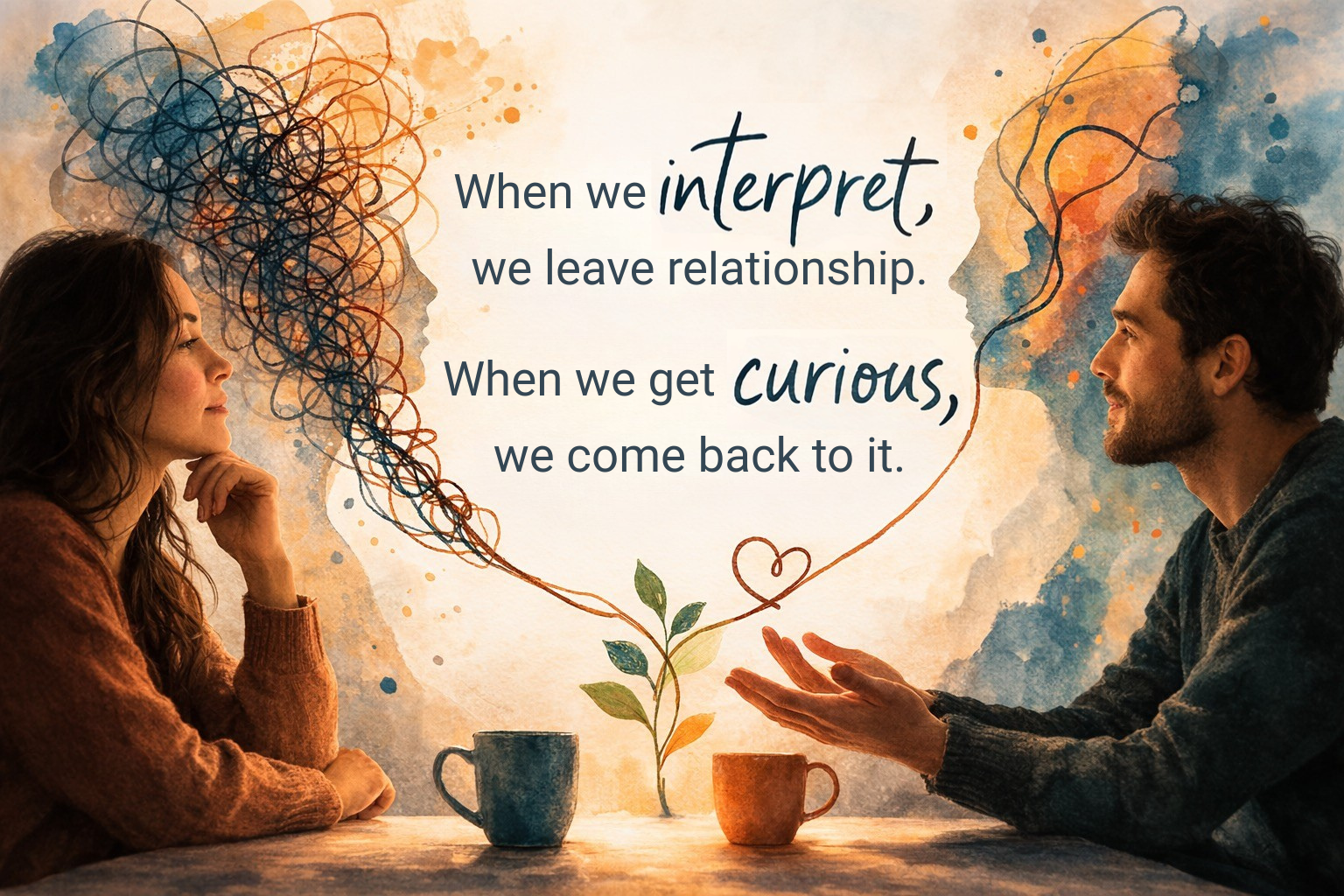
There is a subtle moment in every relationship where we leave the other person and enter our own mind.
It often happens so quickly that we barely notice.
Someone says something.
They look away.
They forget to text back.
Their tone shifts slightly.
And before we know it, our mind fills in the rest of the story.
We move from what actually happened to what we think it means.
This quote captures that moment beautifully:
“When you and I have an interaction, there’s what you do, and there’s my interpretation of it. These are not the same thing.” – J. Levin
In Emotionally Focused Therapy (EFT), we understand this moment through the lens of the attachment cycle.
The full cycle unfolds in five steps, but here I will focus on three of the most important ones.
1. Rapid Appraisal
Our nervous system constantly scans for signals of safety or danger in relationships.
A facial expression.
A delayed response.
A change in tone.
Before we consciously think about it, our brain makes a rapid appraisal.
Is this safe?
Am I important to this person right now?
Am I about to be rejected, dismissed, or abandoned?
This happens automatically and often outside awareness.
2. Meaning Making
Once the brain detects a possible threat, we begin interpreting.
We tell ourselves a story about what the other person’s behaviour means.
Maybe the story is:
- “They don’t care about me.”
- “I’m not important to them.”
- “They’re criticizing me.”
- “I’m about to be rejected.”
- “I can’t rely on them. I’m on my own.”
These interpretations feel incredibly real because they are tied to deeper attachment fears.
But here is the key point:
Our interpretation is not the same thing as the other person’s intention.
Yet once our mind creates the story, our body and emotions respond as if the story is true.
3. Action Tendency (or Protective Move)
Once meaning has been assigned, the body prepares to act.
This is what EFT calls the action tendency.
We might:
- pursue (push harder, demand answers, protest)
- withdraw (shut down, disengage, distance)
- defend (argue, justify, criticize)
- Numb, distract or detach
These reactions make perfect sense from the inside. They are attempts to protect ourselves or restore connection.
But they often trigger the other person’s own cycle, and suddenly two nervous systems are reacting to interpretations rather than actually understanding each other.
When We Are in “Story Mode”
When this happens, something important shifts.
We are no longer responding to the other person.
We are responding to our interpretation of them.
As the quote says:
“If I don’t check out my interpretation with you and get on the same page, I’m not in relationship with you — I’m only in relationship with myself.” – J. Levin
In other words, we are interacting with:
- our fears
- our assumptions
- our story about the situation
The other person has effectively disappeared from the conversation and we are no longer in connection with them.
Returning to Relationship
Getting back into connection requires a different stance.
Instead of defending our interpretation, we become curious about reality.
We slow down and say things like:
- “When you said that, I noticed I started thinking you might be upset with me. Is that what was happening for you?”
- “I realized I might be interpreting this as rejection. I want to check that out with you.”
- “Can you help me understand what was going on for you in that moment?”
This shift moves us from certainty to curiosity.
From being right to wanting to understand.
And that is where real connection lives.
The Heart of Secure Connection
Healthy relationships are not built on perfect communication.
They are built on the ability to notice when we’ve drifted into story mode and gently return to curiosity.
To remember:
My interpretation is not the same as your intention.
And if I want to truly know you, I have to make room for your reality too.